If you’re searching for a clear breakdown of sandbox game evolution, you’re likely trying to understand how open-ended design transformed from simple experimentation into one of the most dominant forces in modern gaming. From early player-driven worlds to today’s expansive, system-rich universes, sandbox games have redefined freedom, creativity, and competitive expression.
This article explores how sandbox mechanics evolved, why they resonate so deeply with players, and how they influence everything from esports strategies to emerging play-centric genres. We’ll examine the design shifts, technological advances, and community-driven innovations that shaped the genre’s trajectory—and what they signal for the future of interactive gameplay.
Our analysis draws on extensive research into game mechanics, competitive play patterns, and developer design philosophies, ensuring you get insight grounded in real-world gameplay trends—not surface-level observations. Whether you’re a competitive player, an aspiring designer, or simply curious about how open-world systems became so powerful, this guide will give you the clarity and context you’re looking for.
From digital blocks to boundless worlds, the sandbox game is built on player freedom, emergent gameplay, and open-ended systems rather than linear objectives. At its core, a sandbox game hands you the tools and says, “Go.” That call to create, explore, and reshape virtual worlds taps into the same instincts that make kids stack LEGO bricks for hours. In contrast to on-rails adventures, these games offer genuine agency, a shift proven by Minecraft’s 300 million copies sold, according to Mojang. Consequently, sandbox game evolution reflects players’ hunger for interactive possibility, transforming simple pixels into sprawling, living universes shaped by imagination.
Before open worlds were marketing bullet points, a few 1980s designers were already handing players the keys. Take Elite (1984). Instead of pushing you down a single heroic path, it dropped you into a procedurally generated galaxy—meaning the universe was created by algorithms, not handcrafted level by level—and said: survive. You could trade goods, hunt pirates, or become one. There was no glowing arrow telling you where to go (a shocking concept for the arcade era).
Many argue these early systems were primitive, mere stepping stones toward modern blockbusters. I disagree. Elite’s sparse structure wasn’t a limitation; it was the thesis. By prioritizing simulation over spectacle, it launched the sandbox game evolution decades before the term was fashionable.
Then there’s the Ultima series. While competitors focused on dungeon crawls, Ultima experimented with persistent worlds—game spaces that continue to change based on your actions. Steal from a town, and guards reacted. Show mercy, and reputations shifted. In other words, choice mattered.
Of course, critics say consequences were shallow compared to today’s sprawling RPGs. Fair. But context matters. In a Pac-Man world of repeating mazes, these games dared to simulate society itself. That pivot—from chasing high scores to shaping worlds—was the revolution.
Building in Three Dimensions: The Leap to Modernity
The late 1990s marked a structural break in game design: the move from flat sprites to fully navigable 3D environments. This wasn’t just a graphical upgrade—it fundamentally changed player agency. With the arrival of 3D acceleration hardware like NVIDIA’s GeForce 256 (1999), developers could render real-time polygons at scale, enabling explorable depth instead of side-scrolling illusion. The result was unprecedented immersion (and yes, camera controls we all wrestled with at first).
The defining milestone was Grand Theft Auto III (2001). Selling over 14 million copies worldwide (Take-Two Interactive financial reports), it established the blueprint for the modern open-world city sandbox. Its design fused narrative missions with systemic freedom—players could follow the story or ignore it entirely. The city functioned as a reactive system:
- Dynamic police escalation based on player actions
- Civilian AI with daily movement patterns
- Drivable vehicles governed by physics rules
This wasn’t linear progression; it was POSSIBILITY SPACE IN MOTION.
Critics at the time argued that 3D worlds sacrificed tight design for empty scale. Early titles did struggle with sparse environments and awkward controls. However, sales data and player retention suggested otherwise: open-world games consistently ranked among top-selling genres through the 2000s (NPD Group industry reports). Engagement rose because players felt ownership over outcomes.
Meanwhile, The Sims (2000) proved the formula wasn’t limited to crime epics. With over 11 million copies sold, it applied sandbox principles to life simulation—complex AI routines, emergent relationships, and needs-based behavior systems. Increased CPU power enabled layered decision trees, making characters respond believably.
Together, these advances defined sandbox game evolution and set the expectation that worlds should feel alive—not staged.
The Indie Explosion: Crafting, Survival, and Infinite Worlds

The indie boom didn’t just add more games to Steam—it rewired the industry. Affordable engines like Unity (launched 2005) and Unreal’s royalty model lowered barriers, and by 2012 indie titles made up a rapidly growing share of digital storefront releases (SteamSpy data). This democratization fueled a true sandbox game evolution, where small teams could rival AAA studios in creativity if not budget.
The Minecraft Effect
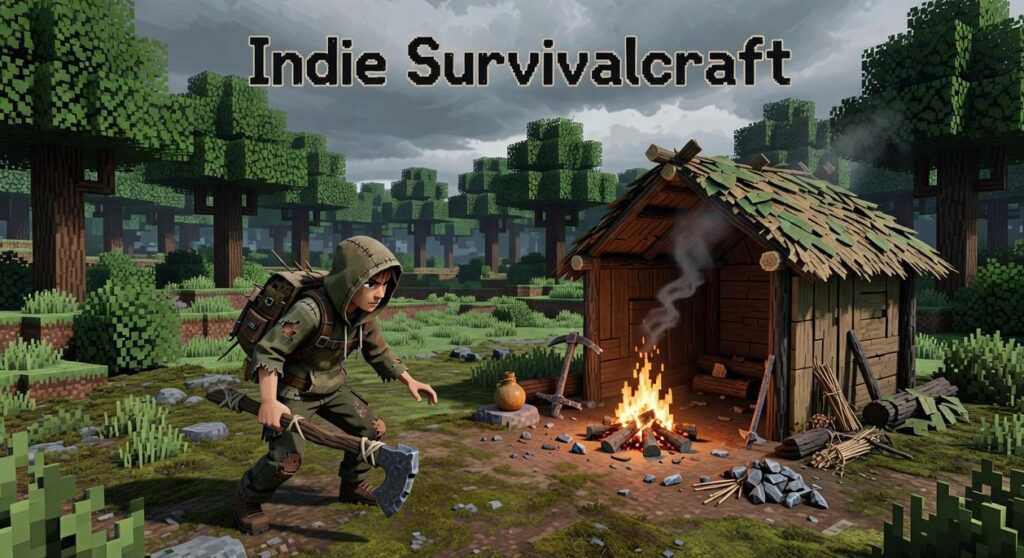
When Minecraft officially launched in 2011, few predicted it would sell over 300 million copies (Microsoft, 2023). Its block-based crafting system—simple cubes, infinite recombination—proved that PLAYER AGENCY beats photorealism. Crafting (combining resources to create tools or structures) became a universal design language. You didn’t just complete objectives; you built your own. Teachers now use it in classrooms; architects prototype ideas inside it (yes, really). That’s USER-GENERATED CONTENT at planetary scale.
Critics argue its graphics were primitive. True. But the data speaks: billions of YouTube views and one of the best-selling games ever. Minimalism became a strength (LEGO energy, but digital).
Procedural Generation and Survival
Procedural generation—algorithmically creating content instead of hand-designing every element—changed scope economics. Terraria (over 44 million copies sold, Re-Logic 2023) used it to create unpredictable 2D worlds. No Man’s Sky famously launched with 18 quintillion possible planets, generated through mathematical formulas.
Pair that with the survival sub-genre—resource management, hunger meters, permadeath—and freedom gains friction.
• Gather, craft, endure.
• Explore, adapt, repeat.
Some players prefer scripted narratives. Fair. But replayability metrics show procedurally generated survival games maintain longer engagement curves (SteamCharts retention data).
For deeper design parallels, see rpg progression systems and their impact on skill growth.
Indies proved one thing: SCALE isn’t about team size. It’s about systems.
The Next Sandbox Frontier
As we look ahead, sandbox game evolution is accelerating across PC hubs from Austin to Seoul. Advanced AI-driven NPCs no longer follow quest scripts; instead, they negotiate, betray, and remember player choices, much like a persistent Dungeons & Dragons campaign. Critics argue emergence is marketing hype, yet studios using behavior trees and machine learning prove otherwise (just watch modders in Garry’s Mod). Meanwhile, next-gen physics engines enable granular destruction—think Unreal Engine 5 chaos simulations reshaping cities. Finally, massively multiplayer shards host thousands in shared worlds, similar to EVE Online’s single-server economy. For design trends, see https://www.gamedeveloper.com.
From the earliest map editors to sprawling procedural worlds, the arc has been clear: creative control keeps moving from developer to player. That steady handoff is the heartbeat of sandbox game evolution. In my view, that’s why the genre endures. We’re not just consuming content; we’re experimenting, tinkering, leaving digital fingerprints behind. Some critics argue structure matters more than freedom, and they’re not wrong—constraints can spark creativity. Still, I believe open systems better mirror human curiosity. Ultimately, these worlds aren’t finished products but canvases, and the next masterpiece is waiting for someone to log in and build it themselves too.
Level Up Your Competitive Edge
You came here to better understand the mechanics, strategies, and trends shaping modern competitive and play-centric gaming — and now you have the blueprint to move smarter and play sharper.
From mastering core systems to adapting to sandbox game evolution, the difference between casual play and consistent wins comes down to strategy, awareness, and execution. The frustration of hitting skill plateaus, falling behind evolving metas, or struggling to translate practice into performance is real — but it’s solvable.
The players who dominate aren’t guessing. They study mechanics, refine tactics, and adapt faster than everyone else.
Now it’s your move. Dive deeper into advanced strategy breakdowns, sharpen your mechanics with proven skill hacks, and apply pro-level insights to your next session. Join thousands of competitive players who trust our #1-rated competitive gaming insights platform to gain their edge.
Stop grinding without results. Start playing with purpose today.